
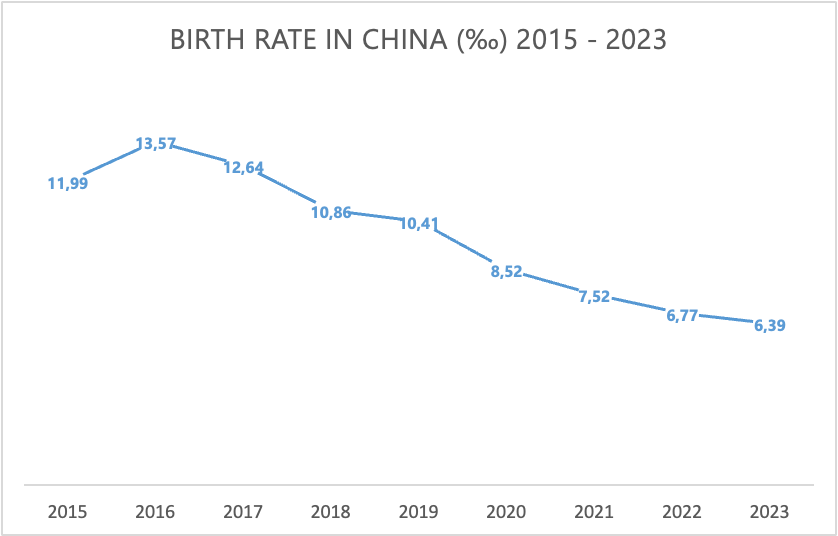
On January 17, the National Bureau of Statistics of China announced the population figures for 2023. The data revealed that by the end of the year, the national population stood at 1,409.67 million, a decrease of 2.08 million compared to the end of 2022. Annual births numbered 9.02 million, down by 540,000 from the previous year, resulting in a birth rate of 6.39 per thousand. Meanwhile, deaths totaled 11.1 million, equating to a mortality rate of 7.87 per thousand, leading to a natural population decrease rate of -1.48 per thousand.

In 2023, China’s population experienced negative growth for the second consecutive year. The Total Fertility Rate (TFR) was approximately 1.0, positioning it as the second lowest among the world’s major economies. The TFR in China has seen a significant decline from about 6 before the 1970s to roughly 2 in 1990, then to about 1.5 after 2010, 1.05 in 2022, and around 1.0 in 2023, slightly above South Korea’s figures. Despite the implementation of comprehensive two-child and later three-child policies, these measures have not effectively reversed the downward trend of China’s birth population. The expected surge in births has largely failed to materialize.
In the short term, a modest rebound in birth numbers and fertility rates is anticipated in 2024, attributed to several factors: 1) the phased realization of pent-up birth plans postponed during the pandemic; 2 an increase in marriages, as evidenced by data from the Ministry of Civil Affairs (MCA), which recorded 5.69 million marriages in the third quarter of 2023, up by 245,000 pairs year-over-year; and 3) the cultural auspiciousness associated with the Year of the Loong, potentially prompting a minor birth peak. However, challenges such as the fading impact of accumulated birth plans, persistently low fertility rates, the shrinking pool of women of childbearing age, and the high costs associated with raising children, complicate efforts to reverse the declining birth population trend without significant, effective pro-birth policies. The slow yet profound demographic shifts demand considerable attention due to their far-reaching implications.
The continuing decline in population growth will inevitably bring about various consequential shifts. Notably:
- The shrinking working-age population and the diminishing potential economic growth rate are prompting a transition from a “demographic dividend” to a “talent dividend.
- As aging intensifies, we move from a period of demographic advantage to one of demographic burden, coinciding with significant growth in the silver economy.
- The trend towards non-marriage has led to an increase in the size of families.
- Urban agglomerations are becoming focal points for population and talent, highlighting the need for urgent reforms in the household registration system as the population living away from their registered households grows.
- While educational attainment is on the rise, social stratification remains a pressing issue that warrants further attention.
Experts have advocated for the complete deregulation of childbirth policies to restore procreation rights to families. Under full liberalization, those disinclined to have children are unlikely to change their stance, but it would enable those desiring more children to fulfill their wishes without concern over a potential surge in birth rates. Effective support for full liberalization would require a comprehensive approach, including measures such as differentiated tax credits, cash subsidies for home purchases, a significant increase in the enrollment rate of children aged 0-3 years, enhanced protection of women’s rights in the workplace, tax incentives for businesses supporting childbirth, increased investment in education and healthcare to alleviate the direct costs of raising children, and strengthened rights for children born out of wedlock to ensure equality.
The introduction of pro-childbirth policies remains to be seen. The falling fertility rates, while concerning, signal a need for the government to address the looming challenges swiftly. Yet, they might also herald new opportunities, particularly in an era of rapid technological progress, opening up novel business avenues to address the demographic shift towards an aging population.
How can we help you?
Yvonne Zhang